2025-08-27

On August 27, a joint research team involving core members of Logical Qubit Technology published the paper Topological prethermal strong zero modes on superconducting processors in the world-leading scientific journal Nature. Using the "Tianmu-2" 100-qubit superconducting quantum chip, the team realized a novel "thermal" topological edge state, providing a new pathway for protecting fragile quantum information.
Symmetry-protected topological edge states are a novel class of quantum states in condensed matter physics that have attracted broad attention in academia. These states can effectively resist noise that preserves specific symmetries and are considered promising for improving the reliability of quantum computing systems. However, topological edge states are highly sensitive to temperature and typically exist only in ideal environments near absolute zero.
The realization of robust topological edge states relies heavily on high-performance superconducting quantum chips. This work was carried out on the self-developed "Tianmu-2" 100-qubit superconducting quantum chip, created with the participation of core members of Logical Qubit Technology.
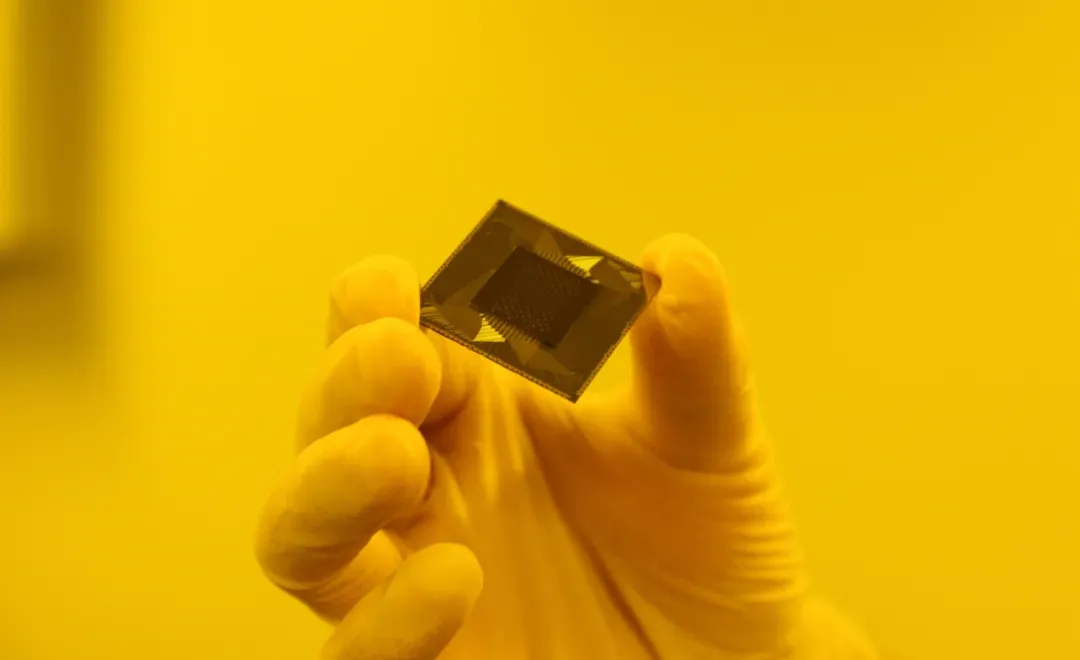
Throughout the experiment, the research team constructed a long chain consisting of 100 particles on the Tianmu-2 quantum chip and engineered dimerized coupling strengths between neighboring particles. Experimental results showed that, even in the presence of substantial thermal excitations within the chain, the topological edge states at both ends maintained lifetimes comparable to those observed in the "zero-temperature" ground state.
High-performance 100-qubit superconducting quantum chips form the foundation for practical quantum computing applications. Equally important is the ability to synchronously control these qubits with extremely high precision, placing stringent requirements on room-temperature quantum measurement and control systems. Without sufficient precision, it would be impossible to observe the dynamics of thermal excitations or realize these novel "thermal" topological edge states.
In this experiment, Logical Qubit Technology's independently developed quantum measurement and control system played a critical role in achieving synchronized high-precision control across 100 qubits. The system features high synchronization accuracy, high precision, and high operational efficiency. Its modular architecture can scale to synchronized measurement and control of thousands of qubits, making it particularly well suited for future large-scale quantum computing applications.

Hangzhou Logical Qubit Technology Co., Ltd. was founded in June 2022. The company's core team members originate from the superconducting quantum computing laboratory at Zhejiang University and have twice set world records for the number of globally entangled qubits in superconducting quantum systems.
In 2021, the team released the 30-qubit "Moganshan-1" and "Tianmu-1" three-dimensional packaged quantum chips. In 2022, the team further achieved superconducting quantum chips exceeding 100 qubits, contributing China's technological strength to the global advancement of quantum computing.
Today, the company's technologies and products are centered on quantum chip design and fabrication. Building upon deep expertise in quantum chips, the company has independently developed a full-stack portfolio of technologies and products including quantum measurement and control systems, quantum computers, and quantum cloud platforms. In 2025, the company significantly exceeded its revenue targets.