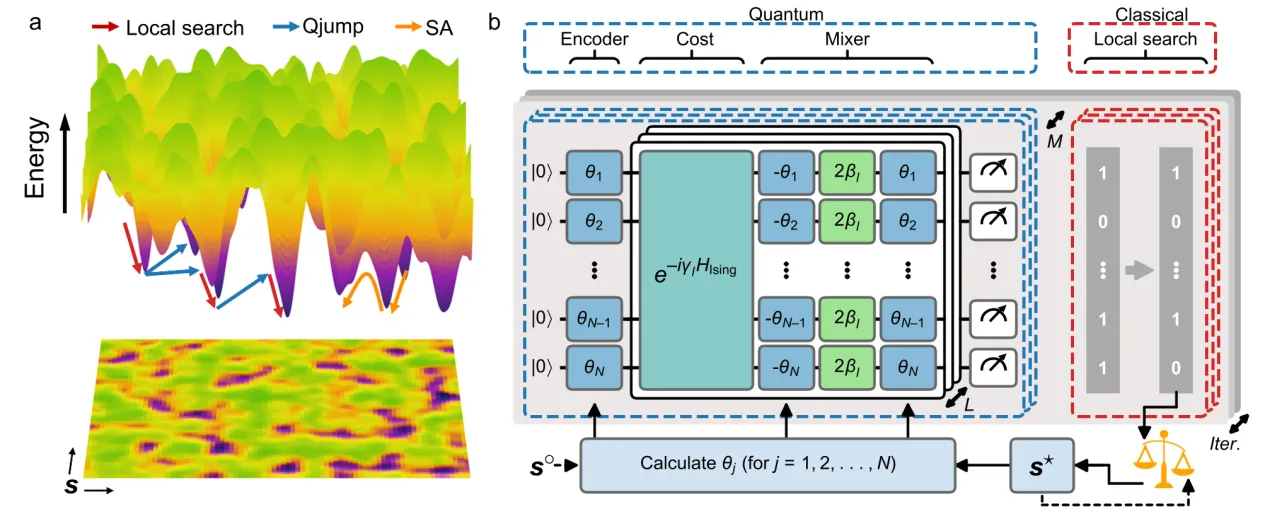
Recently, research results involving core members of Logical Qubit Technology were published in the journal National Science Review, titled "Combinatorial optimization enhanced by shallow quantum circuits with 104 superconducting qubits." The study proposes a quantum-classical hybrid algorithm named "Qjump (Quantum Jump)" and conducts experimental verification based on a hundred-bit superconducting quantum processor. This algorithm combines shallow quantum circuit sampling with classical local search, showing potential to surpass universal classical heuristic algorithms, such as simulated annealing, which do not rely on data structures, when handling complex combinatorial optimization problems. The research demonstrates the potential of large-scale superconducting quantum computing hardware, paving a new path toward the practical application of quantum advantage.
Combinatorial optimization problems are widespread in fields such as logistics scheduling, financial portfolio management, and molecular design. Their solving complexity typically increases rapidly with problem scale, quickly exceeding the capacity of classical computational resources. Quantum computers inherently possess exponentially growing Hilbert space, offering a potential advantage. In the experiment, the quantum sampling part of the Qjump algorithm, once quantum sampling identifies a promising region, the classical local search subroutine immediately takes over to fine-tune and optimize the solution. This collaborative model of "quantum sampling + classical optimization" significantly reduces the requirement for quantum circuit depth, making it feasible to run large-scale algorithms on existing noisy quantum hardware.

High-Precision Quantum Monitoring System Supports Hundred-Bit Quantum Algorithm Execution
Specifically, the research team conducted experimental verification of the Qjump algorithm on the Tianmu-2 superconducting quantum chip (104 qubits), based on Logical Qubit Technology's self-developed monitoring system. This system includes up to 500 signal channels. Since the experiment required synchronous execution of single-qubit and two-qubit gate operations on the hundred-qubit system, it imposed high demands on the system's parallel control capability, clock synchronization accuracy, and operational stability. Experimental results indicate that Logical Bitter Technology's quantum monitoring system can support the stable operation of hundred-qubit-scale quantum algorithms; in relevant tests, the synchronous CZ gate fidelity on the hundred-qubit system reached as high as 99.5%.

Logical Qubit Technology's quantum monitoring system is equipped with an AWG/ADC board chassis, which can be expanded with multiple boards as needed, providing a hardware foundation for controlling larger-scale quantum chips. The system is designed to meet the control requirements of scalable superconducting quantum chips, offering support for future experiments with higher qubit counts.